
One platform, countless applications: the power of Vaast
Amino acids are among the most fundamental and critical molecules in biology, serving as the building blocks of proteins, peptides, and essential metabolic pathways. They’re characterized by a central, tetrahedral carbon functionalized with an amino group, a carboxylic acid, a unique R group side chain, and a hydrogen.
The tetrahedral arrangement of the functional groups around the central carbon gives rise to a chiral center, which is commonly described using the D/L nomenclature familiar to anyone working with amino acids and carbohydrates.
Both D and L amino acids are naturally occurring, however the L form is undoubtedly the most abundant, comprising the peptides and proteins we’re all very familiar with. D amino acids are found much less frequently in areas like the cell wall structure of bacteria, as neurotransmitters in the brain, and in certain foods like cheese and other fermented items.
The R group side chain is primarily where the differentiation between amino acids arises. This side chain can have a very diverse structure and functionality, ranging from acidic, neutral, or basic, heterocyclic/aromatic or alkyl/aliphatic, and the unique case of proline, a secondary amino acid, where the side chain is cyclized onto itself.
This side chain diversity is one of the reasons why there hasn’t been a single chiral column solution for the separation of chiral amino acids. Daicel Chiral Technologies has available CHIRALPAK ZWIX (+)/(-), CHIRALPAK QN-AX/QD-AX, CROWNPAK CR (+)/(-), and CHIRALPAK immobilized polysaccharides, all of which provide separations of the 21 proteinogenic acids we most often encounter in biological analysis. However, each column also requires a different mobile phase, or otherwise a different set of method conditions altogether. Vaast was introduced to eliminate this uncertainty – it’s a single column that can separate all 21 proteinogenic amino acids including the achiral separation of amino acids from each other (like proline from alanine), and also the chiral separation of amino acids (like D-proline from L-proline). Collectively, this means simultaneously resolving 41 distinct compounds from each other (glycine is achiral, so there is no D or L) with a single column and a single method.
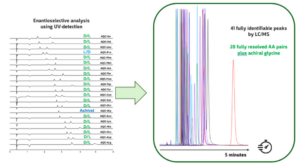
Figure 1: UV chromatograms (254 nm) of 21 AQC-derivatized amino acids on a Vaast column (1.7 μm, 100 × 2.1 mm), with LC/MS overlay identifying 41 peaks under the stated gradient conditions.
Isobaric Amino Acids
Several of these amino acids stand out for their ability to form structural isomers of each other. By definition, structural isomers have the same molecular formula, but differ in the connectivity of their atoms. As a result, they share the same nominal mass, making them challenging to distinguish from each other. Leucine is one example, capable of forming structural isomers isoleucine and allo-isoleucine. Threonine is another with potential to form allo-threonine and homoserine. These structural isomers, or isobaric amino acids, are often missed or unaccounted for in peptide manufacturing processes because of the challenge they present in separation and detection. Vaast is capable of resolving these, giving a more comprehensive impurity profiling compared to conventional analytical methods.
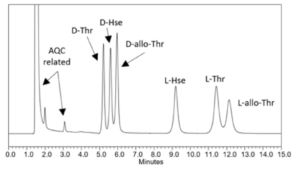
Figure 2: UV chromatograms (254 nm) of AQC-derivatized isobaric amino acid enantiomers on a Vaast column (1.7 µm, 100 × 2.1 mm), including Thr, Hse, and allo-Thr, from simultaneous injections.
Vaast: Resolving Chiral Isobaric Amino Acids
Fmoc-L-Amino Acids
Depending on the length of the amino acid chain, you may see the term peptide used instead of protein. The only difference is the length of the chain – while there is no hard and fast rule, generally anything that is 2 to 50 amino acids long would be called a peptide; anything 51 amino acids and longer is referred to as a protein.
Peptides as therapeutic agents have gained a lot of interest in recent years, particularly with the increased publicity of GLP-1 weight loss drugs. In order to manufacture these peptides, amino acids need to be protected in order to control the way in which they are added or coupled together. Researchers can do this in a number of ways, but Fluorenylmethyloxycarbonyl (FMOC) is one of the more common protecting groups. Vaast is capable of resolving the D and L isomers of these FMOC protected amino acids, while simultaneously maintaining the separation of the unprotected amino acids, which are showing up more frequently as raw material impurities. Even low levels of these impurities can propagate through the peptide synthesis process and negatively affect the final purity and yield. Quantifying them and removing them is a critical aspect of high-quality peptide manufacturing and for regulatory compliance.
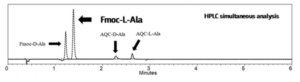
Figure 3: Workflow schematic and overlaid UV chromatograms (254 nm) showing baseline resolution of Fmoc-Ala and AQC-Ala enantiomers on a Vaast column.
Peptides and Peptide Fragments
Once coupled together, should these impurities remain, Vaast is also able to resolve the enantiomer and diastereomer pairs of the resulting 2 and 3-mer peptide snippets. These peptide fragments serve dual roles as synthetic intermediates during peptide manufacturing and as analytical fragments generated during bottom-up proteomic workflows. In both cases, the ability to distinguish stereochemical variants can provide critical information regarding identity, purity, and sequence integrity.
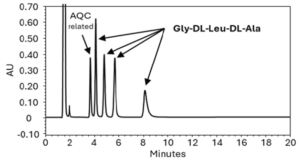
Figure 4: UV chromatograms (254 nm) of AQC-derivatized short peptide enantiomers on a Vaast column (1.7 μm, 100 × 2.1 mm) under UHPLC conditions; elution order undetermined.
Chiral Analysis of Short Peptides and Peptide Fragments with Vaast Column
Application development work continues to uncover new ways Vaast is able to support amino acid analysis. Current applications are being expanded to other types of protecting groups, non-canonical amino acids, other types of acidic molecules, with other projects underway applying Vaast to amino acid analysis in biological systems.
As interest continues to grow in peptide therapeutics, precision nutrition, clinical metabolomics, and the biological significance of D amino acids, the demand for robust amino acid analytical methods will only continue to increase. By providing simultaneous achiral, chiral, and isobaric amino acid separations on a single platform, Vaast represents a fundamentally different approach to amino acid analysis. Ongoing application development continues to expand its utility beyond traditional amino acid workflows, demonstrating Vaast as a versatile analytical tool for both current and emerging areas of life science research.