
The Stereochemical Challenge of Hidden Peptide Impurities: When Molecular Weight Isn’t Enough
Part III: When Molecular Weight Isn’t Enough
In Part 1 we discussed how stereochemical impurities may already exist within amino acid building blocks before peptide synthesis begins. Whether these impurities originate in the starting
Throughout Part 1 and Part 2 we’ve focused primarily on stereochemical impurities, that is molecules that differ only in their three-dimensional arrangement. Modern analytical workflows, particularly when coupled with chiral chromatography, provide increasingly powerful ways to identify these species.
But stereochemistry isn’t the only hidden analytical challenge for amino acids and peptides – sometimes two molecules don’t merely look similar, they have exactly the same molecular weight. So what do we do then?
Molecular Weight Is Only One Piece of the Identity Question
When analytical chemists are faced with the challenge of identifying what are the unknowns in a mixture of compounds, molecular weight is one of the most useful physical properties to know to help answer that question1. Usually that’s enough to give a correct identification.
However for amino acids, molecular weight might only be a part of the answer. Take for example the two amino acids leucine and isoleucine – they have the same molecular formula and same molecular weight. But they are different amino acids, with different biology, different chemistry, and different chromatographic behavior. Mass alone therefore is not going to allow you to accurately and definitively identify one peak as L-leucine and another as L-isoleucine.
Why Isobaric Amino Acids Matter
Structure equals function might have been a phrase that was drilled into your head as a biochemistry undergraduate (at least it was drilled into mine!). This is the overarching theme for biology – structure equals function. Meaning if we swap a leucine for an isoleucine, we change the structure of the peptide, and therefore run the risk of changing the function. Maybe one amino acid changed doesn’t have an effect, or at least not a significant effect, on the function. But start changing two or three, the effect has the potential to compound. So for peptide manufacturers, it’s imperative they be able to ensure their leucine starting material is truly leucine, and not containing some isoleucine.
Protein hydrolysis and fermentation are other applications where distinguishing between leucine and isoleucine can be critical. Substituting one for the other can alter peptide structure and function, influence hydrolysis kinetics, and potentially affect susceptibility to racemization. Although leucine and isoleucine are isobaric, their structural differences can have meaningful implications for these processes.
In short, anywhere where amino acid profiling is a critical workflow, the ability to discriminate between these isobaric amino acids is absolutely critical.
Why Conventional Methods Struggle
We already discussed the fact that these isobaric amino acids have the same molecular weight, so mass spectrometry alone is not going to give an answer as to which peak is which (just like it can’t differentiate between L- and D- amino acids with the same molecular weight).
Reversed phase HPLC, which we talked about in Part 2, does, at times, have the capacity to separate these isobaric amino acids from each other. There is a big question mark though around the surrounding sequence, as this can affect the ability to separate.
We can derivatize the amino acids, perhaps with AQC (see Part 2), or another derivatization protocol. This will help improve detection, and can add a unique handle to the compound which might allow for better selectivity in a given method. However, this derivatization still might not provide enough of a handle for the selector to separate these isobaric amino acids, plus the derivatizing agent also has the same molecular weight, meaning the resulting derivatized isobaric amino acids will still have the same molecular weight.
A Different Dimension of Selectivity
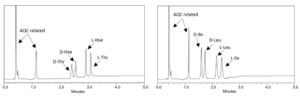
The chromatograms above illustrate how different separation mechanisms can reveal information that molecular weight alone cannot.
So if molecular weight can’t distinguish these compounds, and conventional analytical workflows don’t always provide a definitive answer, where do we go next? Rather than trying to extract more information from the same analytical mechanism, another option is to ask a different analytical question altogether.
Throughout this series we’ve seen that chromatography isn’t simply about separating compounds; it depends entirely on what property of the molecule the stationary phase is capable of recognizing. Reversed-phase chromatography primarily differentiates compounds based on hydrophobicity. Mass spectrometry differentiates compounds by molecular weight. Chiral stationary phases recognize three-dimensional molecular architecture. Ion-exchange chromatography offers yet another perspective.
Amino acids are ideal candidates for ion-exchange separations because their zwitterionic nature provides multiple opportunities for interaction with the stationary phase. Rather than relying primarily on hydrophobicity, ion-exchange chromatography exploits differences in ionic interactions, providing an entirely different selectivity profile than conventional reversed-phase methods.
When combined with AQC derivatization, this approach becomes even more powerful. The derivatization greatly improves UV detectability while preserving the original stereochemical composition of the amino acids2. More importantly, it creates a robust and reproducible analytical workflow capable of simultaneously addressing multiple analytical questions.
Using Vaast, an ion-exchange chiral stationary phase, a high degree of chromatographic discrimination was achieved across the leucine/isoleucine and threonine/homoserine families, including their corresponding enantiomers. Individual D- and L-enantiomers could be separated, enantiomeric excess determined, and the complete families of structurally related isobaric amino acids differentiated within the same analytical platform. Under optimized conditions, even the complete six-member threonine series and five-member leucine series could be resolved chromatographically3. As with many challenging isomeric systems, however, a small number of analyte pairs remain particularly difficult and have, in published methods, been quantified as combined peaks rather than individual species4. Rather than detracting from the method, this highlights the analytical difficulty of these separations and demonstrates how substantially the method expands the molecular information available, even when complete baseline resolution of every analyte is not achieved.
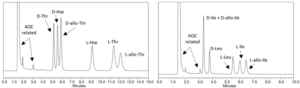
The chromatograms illustrate the additional molecular information that can be obtained when separation is based on more than molecular weight alone. While some isobaric pairs remain challenging, the ability to resolve closely related species expands what can be distinguished within a single analytical workflow.
The important point isn’t simply that another chromatographic separation was achieved. It’s that the chromatographic mechanism itself is answering analytical questions that other analytical techniques were never intended to answer – we can simultaneously distinguish molecular weight, stereochemistry, and structural identity, providing a much higher level of confidence than any one measurement alone.
Why This Matters Beyond One Separation
At first glance, this may appear to be a fairly specialized analytical problem. After all, how often does a laboratory need to separate leucine from isoleucine, or distinguish allo-threonine from threonine? The answer is more often than many people realize.
Peptide manufacturing depends on accurate amino acid identity before synthesis ever begins. Clinical laboratories rely on subtle differences between amino acids as biomarkers for inherited metabolic disorders . Food scientists monitor amino acid composition to understand nutritional quality and authenticity. Metabolomics researchers routinely encounter structurally similar compounds whose biological significance depends entirely on correctly assigning molecular identity.
In each of these examples, the analytical question is the same: Do we know with confidence exactly which molecule we’re measuring? That’s ultimately what this work demonstrates. The value isn’t confined to one group of amino acids or one chromatographic method. It illustrates a broader principle that has quietly emerged throughout this series: analytical confidence is built by collecting complementary pieces of evidence rather than relying on a single measurement.
Looking Ahead
During this series we’ve gradually expanded the analytical question. We began by asking whether stereochemical impurities existed. Then we asked whether those impurities could still be recognized once incorporated into peptides. Finally, we explored whether molecular identity can always be established from molecular weight alone. The final challenge is different.
Analytical laboratories rarely investigate one amino acid at a time. Instead, they are tasked with confidently identifying and quantifying complex mixtures containing many amino acids simultaneously, often under demanding requirements for speed, robustness, and reproducibility.
Can one analytical method realistically address all of these challenges at once?
In the final article of this series, we’ll examine how comprehensive amino acid analysis brings together stereochemistry, structural identity, and quantitative analysis into a single chromatographic workflow.
Citations
1Czerwenka, C.; Lindner, W. Stereoselective Peptide Analysis. Anal. Bioanal. Chem. 2005, 382, 599–638.
2S.A. Cohen, Amino acid analysis using precolumn derivatization with 6-aminoquinolyl-N-hydroxysuccinimidyl carbamate, Methods Mol. Biol. 159 (2000) 39–47. https://doi.org/10.1385/1-59259-047-0:039.
5Kinderstuth, L.; Alvarez, S.; Franco, P. Resolving Chiral Isobaric Amino Acids with Vaast. Daicel Chiral Technologies Application Note, 2026
4R. Karongo, F. Li, F. Fiessinger, J. Horak, M. Lämmerhofer, 2025. Automated derivatization with 6-aminoquinolyl-N-hydroxysuccinimidyl carbamate for the enantioselective amino acid analysis of neurotensin synthesized by liquid-phase peptide synthesis, J. Pharm. Biomed. Anal. 263, 116916. https://doi.org/10.1016/j. jpba.2025.116916.
5C. Knappe, S.J. Jaag, T. Dema, R. Jaufmann, S. Buckenmaier, H. Gross, S. Grond, M. Lämmerhofer, Multicolumn two-dimensional liquid chromatography screening platform for stereopeptidomics and application to antimicrobial peptide polyene and lipopeptide, Anal. Chem. 97 (2025) 14048–14057. https://doi.org/10.1021/acs. analchem.5c02658.