
The Stereochemical Challenge of Hidden Peptide Impurities: The Hidden Impurities in Starting Materials
Part I: The Hidden Impurities in Starting Materials
When we think about impurities in the peptide manufacturing process, the focus is almost always on those generated during synthesis. There are numerous, well-understood side reactions, including, but not limited to, incomplete couplings, deletion sequences, deamidation, oxidation, aggregation, and unwanted cleavage or deprotection reactions. It’s possible that one or a combination of some can happen at one or each step of the coupling process. Regardless of their combination or frequency, they directly influence yield, purification efficiency, and ultimately the quality and consistency of the final product. Which is why entire process development programs are dedicated to minimizing these pathways.
Therefore, a successful peptide synthesis is highly dependent on the efficiency and control of every coupling step. But even a well-controlled coupling step can be negatively impacted by the quality of the starting materials introduced into the process. A 50-residue peptide requires 50 sequential coupling reactions, each relying on a new amino acid building block. Even small levels of impurities introduced at any one of those steps become part of the manufacturing process and, in some cases, part of the finished product.
So, while considerable attention is paid to impurities generated during synthesis, it’s worth dedicating some time to discuss the impact of those less discussed, that is those present before any coupling takes place. Take for example an Fmoc-protected amino acid – while the expectation is 100% FMOC-L-alanine, the reality is it may include residual free L-alanine, the corresponding FMOC-D-alanine, or free D-alanine. Depending on the impurity, the result may be reduced synthetic efficiency, reduced purity, or the incorporation of unintended molecular variants into the peptide itself.
As peptide therapeutics continue to grow in complexity, and expectations for impurity characterization continue to evolve, it is worth asking a simple question: How well do we understand the stereochemical purity of the amino acid building blocks we start with? And then: What can we do about it?
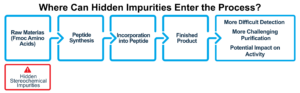
Chemical Purity is Not Necessarily Stereochemical Purity
Anyone who has spent time in peptide manufacturing knows how much emphasis is placed on incoming raw material quality. Suppliers compete on reported purity because even seemingly small improvements can have meaningful effects across a multistep synthesis. Manufacturers routinely verify certificates of analysis through incoming quality control before materials are released into production. When we see a reported purity of 99.5% or 99.9%, we have to be careful to not assume the material is essentially perfect. We need to have a decerning eye towards what this specification is truly a measure of – almost always it’s a description of chemical purity only, not stereochemical purity, and that distinction is important.
The chromatographic methods commonly used for release testing are going to be achiral reversed-phase methods. These are excellent and well-established for detecting many chemical impurities, but they cannot distinguish an L-amino acid from its corresponding D-isomer. Likewise, unless specifically developed for that purpose, they may not fully resolve protected amino acids from related deprotected species. A material can therefore satisfy its chemical purity specification while still containing small amounts of stereochemical impurities that remain analytically invisible, yet critically impactful to the peptide manufacturing process.
Replacing a single L-amino acid with its D-counterpart leaves the molecular formula unchanged, but can alter peptide conformation, receptor binding, enzymatic stability, or biological activity. From a manufacturing perspective, it introduces an impurity that is inherently more difficult to detect than many traditional synthetic byproducts (as we’ll discuss), and more difficult to remove.
Small Imperfections Become Significant
One of the fundamental principles of manufacturing is that small imperfections accumulate. Peptide chemists understand this intuitively, so while no individual coupling reaction is expected to proceed with perfect efficiency, even small improvements made at each step can translate into meaningful improvements in overall process performance.
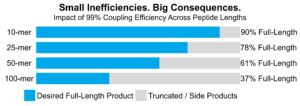
The same principle applies to raw material quality. Let’s consider a simplified example: the manufacturing of a 50 residue peptide where each amino acid building block has a reported chemical purity of 99.8%. If we make the simplifying assumption that the remaining 0.2% consists entirely of material unavailable for productive synthesis, the theoretical maximum amount of usable material remaining after fifty sequential additions is approximately: 0.998^50= 90.5%
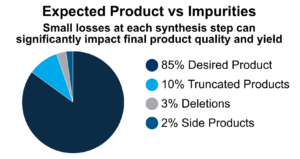
Illustrative example demonstrating how synthesis-related impurities can accumulate as peptide length increases. Actual impurity profiles vary depending on sequence, chemistry, and synthesis conditions.
In other words, before considering coupling efficiency, incomplete reactions, cleavage losses, purification losses, or any of the other realities of peptide manufacturing, approximately ten percent of the theoretical material has already been lost simply because small imperfections were repeated over many synthesis steps.
Of course, real manufacturing is considerably more complex than this simplified calculation. Different impurities behave differently. Some never participate in the reaction, some terminate synthesis, while others may simply pass through the process. The purpose of the calculation is not to predict manufacturing yield, but to illustrate an important concept: small deviations become significant when repeated dozens of times.
The peptide industry has recognized this principle for decades. It is one of the reasons suppliers continually strive for incremental improvements in raw material quality, and why manufacturers are willing to pay a premium for consistently high-quality starting materials. A seemingly insignificant improvement of just a few tenths of a percent in raw material purity can have a meaningful impact when multiplied across an entire synthesis campaign.
When The Impurity Becomes the Product
Unlike these other non-stereochemical impurities, the concern with stereochemical impurities isn’t just that they lead to lower product yields or decreased coupling efficiencies. Because they’re incorporated into the peptide sequence, they have the potential to alter peptide conformation, receptor binding, enzymatic stability, or biological activity.
Knowing (and potentially removing) these stereochemical impurities before synthesis takes place would be a major advantage for any peptide manufacturer. The synthetic process has no way to adjust for the presence of these stereochemical impurities, so if they’re present, there is a good chance they’re going to be incorporated in the sequence (assuming their coupling efficiencies are roughly the same). Now the stereochemical impurity is no longer isolated to the starting material, it’s been incorporated into the eventual final product population.
Let’s say for example a peptide sequence containing a single leucine residue synthesized from an Fmoc-L-leucine building block containing 0.2% Fmoc-D-leucine. Assuming comparable coupling behavior, approximately 0.2% of the finished peptide population may now contain a D-leucine substitution at that position.
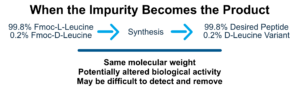
A stereochemical impurity present in a starting material may become incorporated directly into the final peptide population.
Now consider a longer peptide synthesized from twenty or thirty different amino acid building blocks, each carrying its own impurity profile. While the actual outcome depends on the sequence, coupling efficiencies, and the quality of each individual starting material, the probability of generating peptide molecules containing at least one unintended stereochemical substitution increases as additional building blocks are introduced into the synthesis.
These molecules are not incomplete products or side reactions, they are in fact fully formed peptide molecules. The only difference is the stereochemistry of one or more amino acid residues, and if you’re reading this and you’ve done peptide synthesis before, you know the challenge associated with trying to separate and identify these impurities in a final peptide product.
Racemization Is Not Limited to Peptide Synthesis
It’s worth acknowledging at this point that stereochemistry is hardly an unfamiliar topic to peptide chemists. In fact, epimerization (or racemization) is well-understood and frequently discussed as a part of the manufacturing process. Epimerization has been studied extensively, and modern coupling reagents and optimized reaction conditions have dramatically reduced its occurrence for many amino acids2,3.
However, coupling chemistry is only one possible source of stereochemical impurities, and that is perhaps the point of this whole piece. As we’ve already discussed, minor amounts of D-amino acids or other stereochemical variants may already be present within incoming amino acid building blocks as a result of their own synthesis, purification, handling, or long-term storage. This is not a criticism of raw material manufacturers by any means. Producing highly pure amino acid derivatives is technically demanding, and today’s suppliers produce materials of exceptional quality.
Rather, it highlights an analytical blind spot. We often assume that because a material satisfies its chemical purity specification, its stereochemical composition is equally well understood, but those are not necessarily the same question.
For achiral analytical methods, an L-amino acid and its corresponding D-isomer are indistinguishable. If stereochemistry is not specifically measured either indirectly with a chiral derivatization, or directly with a chiral analytical method, small amounts of stereochemical impurity may simply go unnoticed until they have already been incorporated into the peptide manufacturing process.
Why Purification May Not Solve The Problem
With a number of the non-stereochemical impurities we discussed, there has been extensive work done to establish efficient purification processes to remove them downstream. Deletion sequences often differ sufficiently from the target peptide to allow for chromatographic separation. Oxidized species frequently exhibit measurable changes in retention. Numerous side products generated during synthesis differ enough in their physicochemical properties that purification methods can be optimized to reduce them to acceptable levels.
Stereochemical impurities are different, because while replacing a single L-amino acid with its D-counterpart can change the three-dimensional structure of the peptide, the elemental composition is unchanged, meaning the molecular weight remains identical, and depending on the sequence and the location of the substitution, even the overall hydrophobicity may change very little.
Sometimes these peptide variants separate well chromatographically; sometimes they separate only marginally; and sometimes they appear almost indistinguishable under conventional analysis conditions.
There is no universal expectation that a purification method developed to remove deletion sequences or other synthetic byproducts will also resolve every stereochemical variant. Separation depends on the specific peptide, the position of the substitution, the chromatographic mode, and the selectivity of the stationary phase.
The important point is not that these impurities cannot be removed. It is that they cannot be assumed to be removed. From a manufacturing perspective, preventing their incorporation is often considerably simpler than attempting to eliminate them after synthesis has been completed.
The Analytical Challenge
The analytical challenge mirrors the purification challenge. Modern peptide characterization relies heavily on powerful analytical techniques. High-resolution mass spectrometry provides extraordinary confidence in molecular identity. Reversed-phase LC offers robust impurity profiling. Peptide mapping provides detailed structural information. Collectively, these tools have transformed peptide development over the past several decades.
Each technique, however, answers a different analytical question. Mass spectrometry determines molecular mass. Reversed-phase chromatography separates compounds based primarily on their interactions with the stationary and mobile phases. Neither technique directly measures stereochemistry.
A peptide containing a single D-amino acid substitution has the same elemental composition and the same molecular weight as its all-L counterpart. Consequently, both molecules produce the same molecular ion in the mass spectrometer. From the perspective of mass alone, they are indistinguishable.
Likewise, reversed-phase chromatography may or may not separate them depending on the sequence and chromatographic conditions employed. In some cases, the conformational change introduced by the D-amino acid produces sufficient selectivity for separation. In others, retention is remarkably similar and the two species may co-elute.
This is an important distinction. The absence of an observable impurity peak does not necessarily demonstrate the absence of a stereochemical impurity. It may simply reflect the limitations of the analytical method being used.
That is not a weakness of mass spectrometry or reversed-phase chromatography. They were never designed to answer questions of stereochemistry. They answer the questions they were intended to answer exceptionally well. The challenge is recognizing when an additional analytical dimension is needed.
An Upstream Opportunity
Over the past two decades, pharmaceutical manufacturing has steadily shifted from end-product testing toward process understanding and risk-based quality systems. Quality is no longer viewed as something that can simply be tested into a product after manufacturing has been completed. Instead, it is developed through understanding the process, identifying potential sources of variability, and controlling them as early as practical4,5.
For peptide manufacturing, amino acid building blocks represent one of the earliest opportunities to influence final product quality. If stereochemical impurities originate in the starting materials, waiting until the finished peptide has been synthesized to begin looking for them may be unnecessarily late in the manufacturing process. By that point, those impurities have already had the opportunity to become incorporated into the product population.
Evaluating stereochemical purity upstream offers a different approach. Rather than asking whether stereochemical impurities can be removed after synthesis, it asks whether they can be identified before they are introduced into the process.
For manufacturers seeking to better understand their impurity profile, this represents another layer of process knowledge. It is not intended to replace existing analytical workflows, but to complement them by answering a question that conventional analytical methods may not always address.
Recent advances in chiral amino acid analysis have made upstream stereochemical characterization increasingly practical. Methods are now available that can simultaneously resolve D- and L-amino acid enantiomers while distinguishing protected and unprotected forms within a single analytical workflow. For peptide manufacturers, this creates a new opportunity to better understand starting material quality before those materials become incorporated into the finished product.
One example of this approach is Daicel Chiral Technologies’ recently introduced Vaast chiral stationary phase, which was specifically developed for this type of amino acid analysis. Rather than replacing existing QC workflows, it provides an additional analytical dimension that conventional achiral methods cannot offer.
Looking Ahead
So far, we’ve focused primarily on analyzing raw materials and identifying stereochemical impurities before they enter the peptide manufacturing process. But what happens when racemization or epimerization occurs during synthesis itself?
That’s where the story becomes even more interesting.
In Part 2: The Hidden Stereochemical Impurities in Peptides, we’ll explore how these stereochemical variants can be introduced during coupling reactions, why they can be difficult to detect, and the impact they can have on peptide quality, purity, and performance.
The good news? Vaast is capable of separating these species as well, extending its utility beyond raw material analysis and into the characterization of peptide products and intermediates. Stay tuned as we take the next step in uncovering hidden stereochemical impurities.
Citations
1Merrifield, R.B. Solid Phase Peptide Synthesis. I. The Synthesis of a Tetrapeptide. J. Am. Chem. Soc. 1963, 85, 2149–2154.
2Han, S. Y.; Kim, Y. A. Recent Development of Peptide Coupling Reagents in Organic Synthesis. Tetrahedron 2004, 60, 2447-2467.
3Albericio, F. Developments in Peptide and Amide Synthesis. Current Opinion in Chemical Biology 2004, 8, 211-221.
4International Council for Harmonisation (ICH). ICH Q11: Development and Manufacture of Drug Substances (Chemical Entities and Biotechnological/Biological Entities). 2012.
5International Council for Harmonisation (ICH). ICH Q9(R1): Quality Risk Management. 2023.


Trackbacks & Pingbacks
[…] Part 1 we discussed how stereochemical impurities may already exist within amino acid building blocks […]
[…] Part 1 we discussed how stereochemical impurities may already exist within amino acid building blocks […]
Comments are closed.